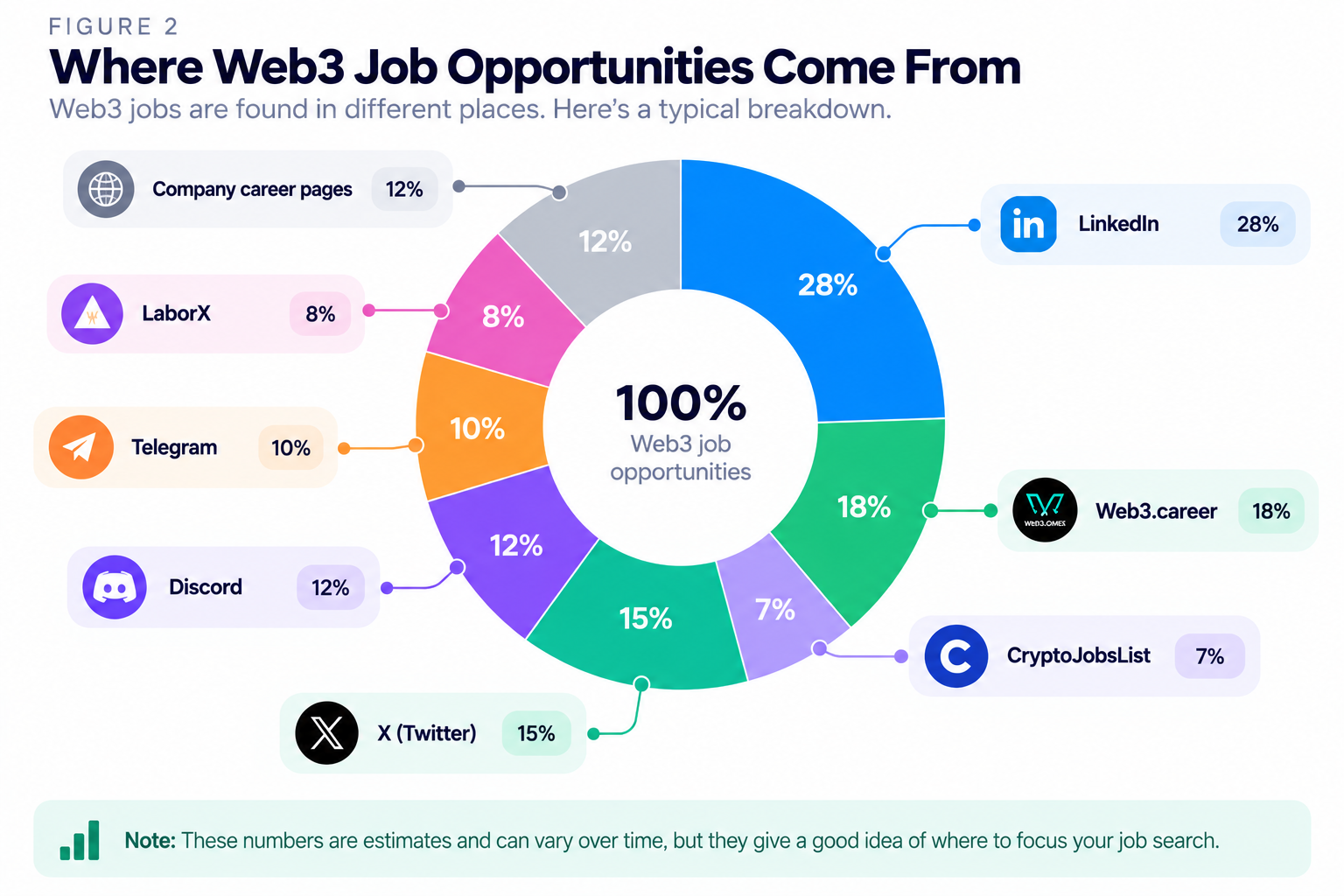
A beginner can spend weeks searching for “Web3 jobs” and still feel like there are no opportunities. That usually happens because Web3 hiring is spread across different places. Some companies use dedicated crypto job boards. Some post roles on LinkedIn. Others announce openings on X, Discord, Telegram, or their own careers page.
The goal is not to create an account on every platform and apply to everything. Start with a small number of reliable places, search for roles that match your current skills, and build a repeatable application routine.
Before You Start Applying
Do not begin with the application button. First, decide what type of work you can realistically do. Web3 is an industry, not one job.
Writing: technical writing, content writing, copywriting, documentation and research.
Community: community management, moderation, ambassador programmes and ecosystem support.
Marketing: social media, growth, partnerships, campaigns and product marketing.
Design: product design, UI/UX, brand design, motion design and graphics.
Technical roles: frontend, backend, smart contracts, DevRel, security, data and protocol engineering.
Operations and business roles: customer support, product operations, project management, business development, compliance and sales.
Pick one main direction first. You can still apply to closely related roles, but searching for everything at once makes it difficult to build a strong CV, portfolio and application.
Quick quiz
A beginner wants to find a Web3 writing role. Which approach best matches the recommended job-search method?
If you’re still figuring out how to approach your Web3 job search, read our guide on How to Get Your First Web3 Job.
1. Web3.career
Web3.career is a dedicated Web3 job board with roles across engineering, marketing, design, product, operations, research and other functions. It is useful when you want a large pool of crypto-native companies in one place.
How to use it
Search for the exact role you want instead of using only the word “Web3.” Try searches such as content writer, community manager, product designer, Solidity developer or business development.
Use filters for remote work, location, seniority, salary or technology when they are relevant.
Open the job description and check the location restrictions. “Remote” does not always mean worldwide.
Check the date of the listing. Give newer, relevant roles more attention than old vacancies.
How to apply
Read the full description before leaving the job board. Identify the skills the company repeats, the product it is building and the exact application method. When the listing redirects you to the company website, apply there and follow the instructions on that page.
2. CryptoJobsList
CryptoJobsList focuses on crypto, blockchain and Web3 roles. It includes technical and non-technical jobs, remote filters, role tags and company listings. Candidates can also create a talent profile so companies can discover them.
How to use it
Use the role and location search instead of scrolling through every vacancy.
Check tags such as remote, non-technical, marketing, design, developer or Web3 to narrow the results.
Save or bookmark the roles you want to compare before applying.
If you create a talent profile, make the headline specific. “Web3 professional” is weak. “Technical Writer | Blockchain and Crypto Content” tells a recruiter what you do.
How to apply
CryptoJobsList listings may collect applications directly or send you to an external form. Prepare your CV, portfolio, LinkedIn and other relevant profiles before you start. Some employers also request a cover letter or screening answers, so do not rush through the form.
3. LaborX
LaborX combines Web3 vacancies with freelance work. This makes it useful for beginners who are open to contract work, short projects or a first paid Web3 experience. The platform also supports digital contracts and crypto payments.
How to use it
Separate full-time vacancies from freelance jobs so you know what kind of commitment the client expects.
Build a complete profile around the service you can deliver.
For freelance work, show samples that prove you can do the exact task being requested.
Read the payment terms, deadline, scope and platform fees before accepting work.
How to apply
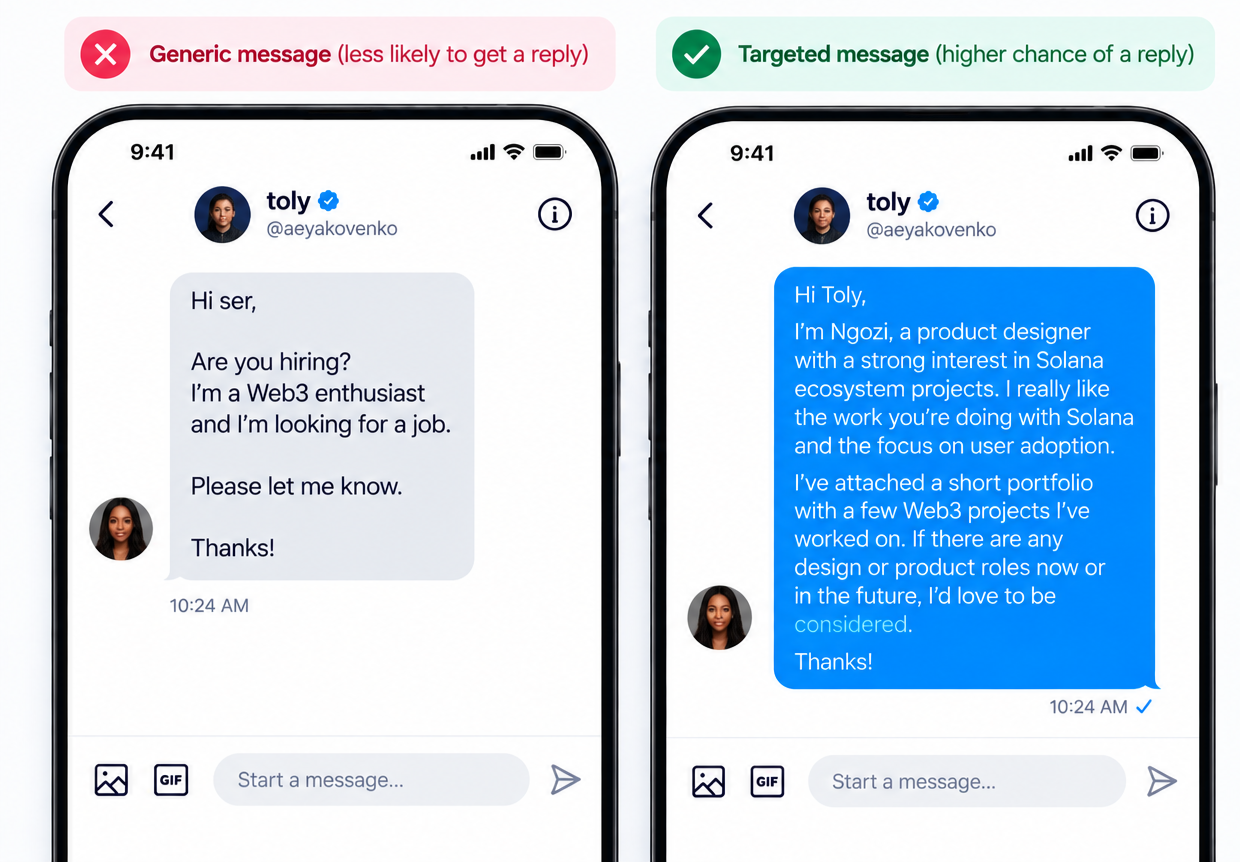
For a freelance opportunity, do not send a generic message such as “I am interested.” Tell the client what you can do, point to one or two relevant samples, and explain how you would approach the work. Keep it short enough to read quickly.
4. LinkedIn
LinkedIn is not a Web3-only platform, but many blockchain companies and recruiters use it. It is especially useful because you can search for the job and then research the company, recruiter and employees in the same place.
How to search
Use specific searches: “Web3 content writer,” “crypto community manager,” “blockchain product designer,” “Solidity developer,” or the exact role you want.
Turn on job alerts for your strongest searches.
Filter by date posted. A role posted recently may be worth prioritising.
Follow companies you genuinely want to work for and watch their posts as well as their Jobs tab.
How to apply
If the company provides its own application page, use it. After applying, a short, relevant message to the recruiter or hiring manager can help, but the message should add context rather than simply say that you applied.
5. X (Twitter)
X is important in Web3 because founders, contributors, recruiters and project teams often announce opportunities publicly before they spread across job boards.
How to search
Search phrases such as “we are hiring,” “hiring writer,” “hiring community manager,” “Web3 jobs,” “crypto jobs,” or the role name plus “hiring.”
Use the Latest tab when you want recent posts rather than only popular posts.
Follow the projects and people working in the area you want to enter.
Check the account and company before responding. A hiring post is not automatically legitimate because it has a Web3 logo.
How to apply
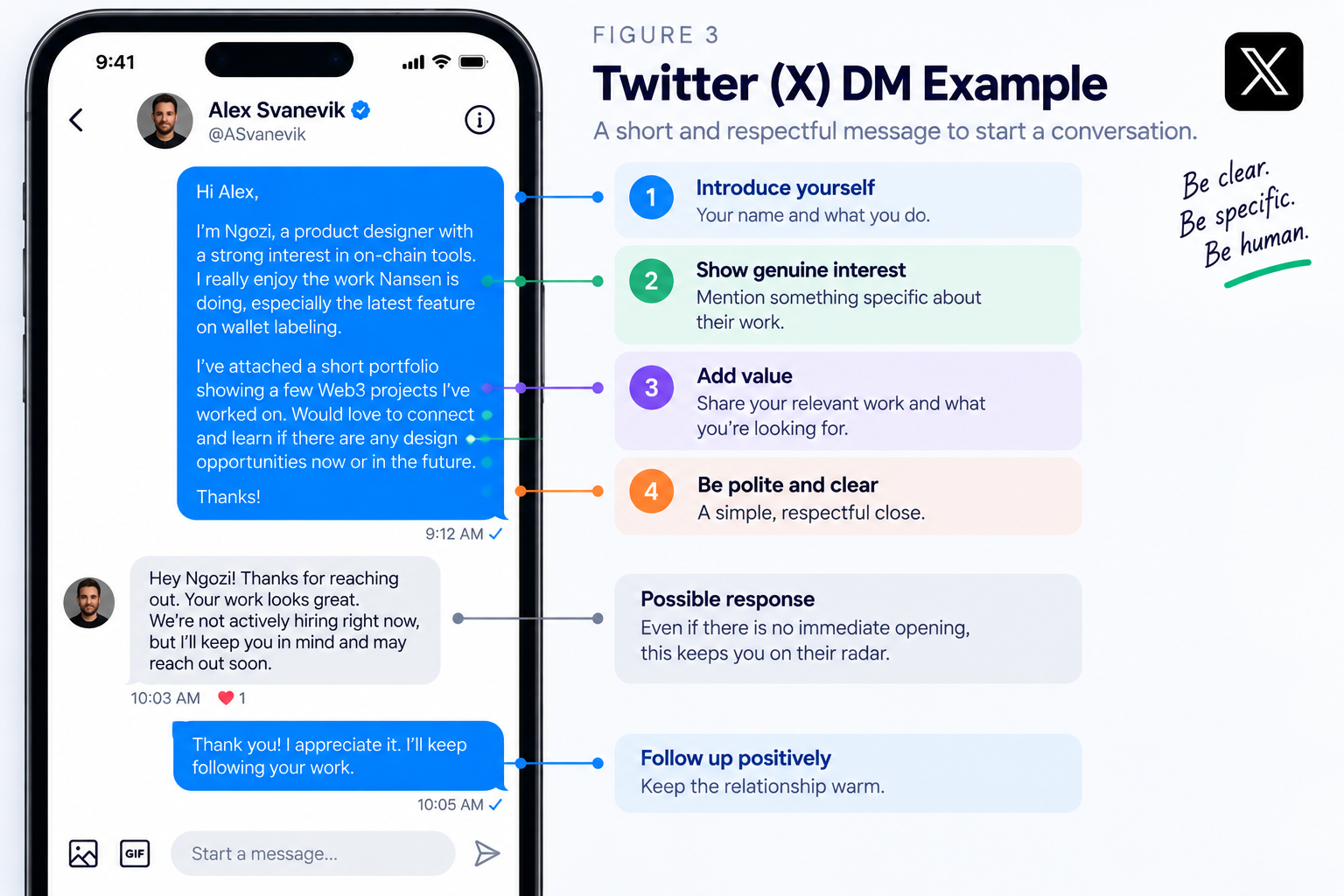
Follow the instructions in the post. If the person asks for a form, use the form. If they request a DM, send a concise introduction, your relevant proof of work and the information they requested. Do not turn every public hiring post into an unsolicited long pitch.
Get new Decode Web3 posts in your inbox.
Add any other topics you want to receive.
6. Company Career Pages
One of the simplest methods is to go directly to the companies you want to work for. Make a list of 20 to 30 Web3 companies that operate in areas you understand or want to learn: wallets, exchanges, infrastructure, DeFi, payments, gaming, analytics, security, developer tools or other sectors.
How to use this method
Visit the official company website and find Careers, Jobs or Join Us.
Check whether the role is remote and whether your country or time zone is eligible.
Read about the product before applying.
Return to the page regularly or subscribe to job alerts if the company offers them.
This method reduces the temptation to apply blindly. You already know which companies you are tracking, so your applications can be more specific.
7. Web3 Communities: Discord and Telegram
Communities can expose you to contributor roles, bounties, internships, ambassador programmes and jobs that may never reach a large job board. They are also useful for learning how a project communicates and what the community actually needs.
How to use communities properly
Join the official community from the project’s verified website or official social account.
Look for channels named jobs, opportunities, contributors, bounties, grants or announcements.
Participate normally before asking people for jobs. Useful contributions make your name familiar.
Never send money, a seed phrase or private keys because someone claims you must pay to get hired.
Quick quiz
Which portfolio would be most relevant for someone applying for a Web3 content-writing role?
How to Know Whether a Web3 Job Is Worth Applying For
You do not need to meet every line in a job description. You do need to understand the core requirements.
Check | What to look for |
Role fit | Can you perform most of the main responsibilities, or show evidence that you can learn the missing part quickly? |
Location | Does the company hire in your country or time zone? |
Experience level | Is the role genuinely junior, mid-level or senior? |
Proof of work | Do you have samples that match the work the employer wants? |
Company legitimacy | Does the company have a real product, official website, identifiable team or credible public history? |
Application instructions | Did the employer ask for a CV, portfolio, GitHub, writing samples, form answers or something else? |
How to Apply for a Web3 Job Properly
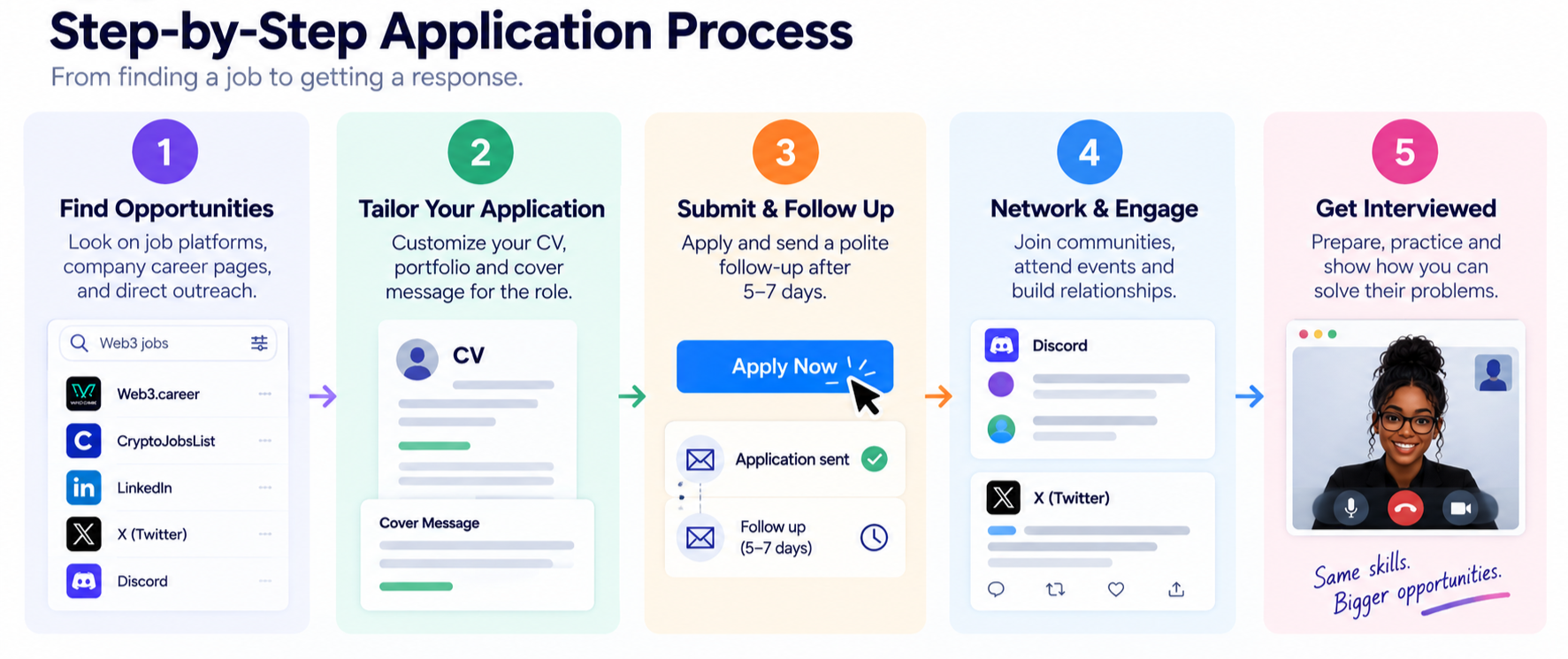
Step 1: Read the job description twice
The first read tells you what the role is. The second read tells you what the employer cares about. Note the main responsibilities, required skills, location, experience level and application instructions.
Step 2: Adjust your CV for the role
Do not rewrite your entire career for every application. Change the parts that matter. Put the most relevant experience, tools, results and projects where the recruiter can see them quickly. If you need help creating a professional CV, you can use a CV builder to create and customise one for your target role.
Step 3: Send the right portfolio
A portfolio should reduce doubt. A writer needs strong published or sample articles. A designer needs case studies or finished designs. A developer needs working projects and readable repositories. A community manager can show campaigns, community systems, reports or measurable growth. Three relevant samples are usually more useful than twenty unrelated ones.
Step 4: Answer screening questions like a human
Do not copy the same paragraph into every form. Answer the actual question. Use a specific example when the employer asks about your experience. If you have not done the exact task before, say what closely related work you have done and how it transfers.
Step 5: Write a short cover note when one is required
A useful cover note connects three things: the role, your relevant experience and proof. Avoid starting with a long story about how passionate you are about blockchain. Show why your background makes sense for that particular job.
Step 6: Track the application
Use a simple spreadsheet or Notion table. Record the company, role, link, date applied, contact person, status and follow-up date. Without a tracker, it is easy to forget where you applied or accidentally apply twice.
Step 7: Follow up once when it makes sense
If you have a legitimate recruiter or hiring contact and the company has not told applicants not to follow up, send one short follow-up after a reasonable interval. Do not message several employees every day. Persistence is useful; pressure is not.
A Simple Beginner Application Routine
Common Mistakes Beginners Make
Applying for ten completely different career paths with the same CV.
Calling yourself a Web3 expert without showing any work.
Using one generic cover letter for every company.
Ignoring location and time-zone restrictions.
Sending a portfolio full of unrelated samples.
Paying someone to unlock a job, interview or salary.
Connecting a wallet or signing an unknown transaction because a recruiter asked.
Sharing a seed phrase, private key, password or other wallet recovery information.
Assuming every opportunity posted in a Discord server, Telegram group or X thread is legitimate.
What If You Have No Web3 Experience Yet?
You can build proof before a company gives you the title.
- Write an article explaining a protocol.
- Redesign a real Web3 product screen as a case study.
- Build a small dApp.
- Create a community growth plan.
- Analyse a project’s onboarding flow.
- Contribute to documentation or an open-source project where appropriate.
The work should match the job you want. A beginner portfolio is strongest when it shows that you understand the type of problem the employer is hiring someone to solve.
Final Note
Getting a first Web3 job is usually a combination of skill, proof of work, visibility and consistent applications. The platform only helps you find the opportunity. What happens after that depends on how well your CV, portfolio and application show that you can do the work.
Start with a few reliable platforms, search with specific job titles, verify the company, and apply with relevant proof. Then keep improving the parts of your application that are not getting responses.
Join the conversation
What stayed with you? Leave a thought or a question. Comments appear after approval.
Loading comments…