Getting your first Web3 job can feel confusing. You open a job post and see words such as wallet, protocol, token, DAO, DeFi, smart contract and on-chain experience. The company may ask for two years of experience even though the industry itself is still developing quickly. You may know that people work in Web3, but you may not know where you fit or what to do first.
The good news is that you do not need to become a blockchain developer before you can work in Web3. The industry needs writers, designers, community managers, marketers, researchers, product managers, customer support specialists, business developers and many other professionals. Your task is to understand the environment, choose one useful role and create evidence that you can do the work.
This guide gives you a complete starting strategy. It explains Web3, shows the roles available, teaches you how to build a portfolio without waiting for employment, and provides practical ways to find and approach companies. It also includes examples you can adapt.
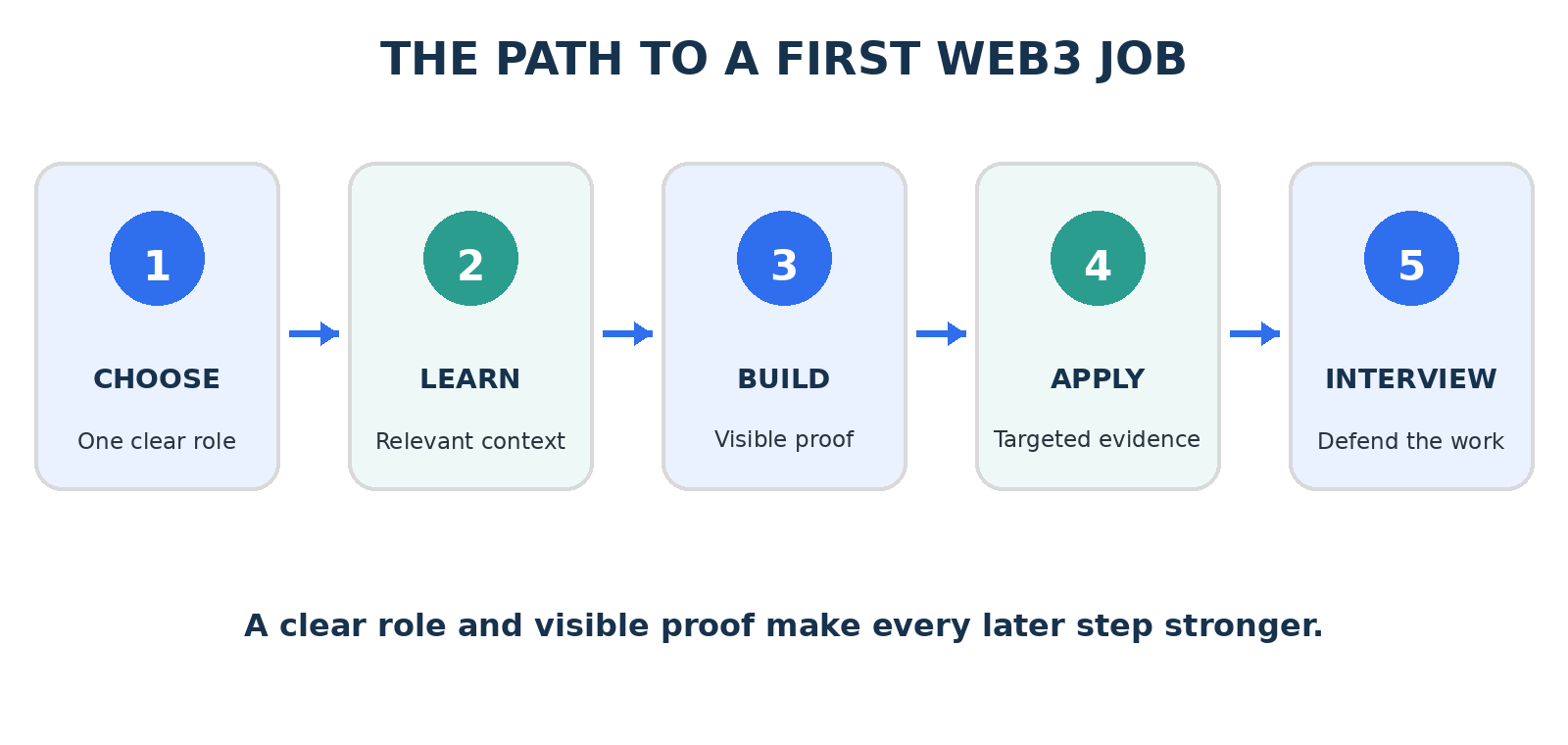
The central idea is simple: do not wait for a company to give you experience. Build small relevant proof of work, make that work easy to see, and place it in front of the people who need it.

Quick quiz
What kinds of skills are transferable into Web3 roles?
Getting Your First Web3 Job
Most people who land their first blockchain job do it by building visible proof of interest and competence long before they ever apply for a formal position.
That might mean contributing to an open source protocol, writing a few thoughtful posts about a project you follow closely, joining a DAO's community channels and actually showing up, or picking one small technical skill and demonstrating it publicly.
The main parts of the industry
Area | What it does | Examples of work |
|---|---|---|
Blockchains and infrastructure | Builds the networks, developer tools, data systems and security layers that other products use. | Engineering, documentation, developer relations, research |
Wallets and custody | Helps users access, store or manage digital assets and sign transactions. | Product, support, UX writing, security education |
Exchanges and payments | Allows people or businesses to buy, sell, transfer or spend digital assets. | Compliance, operations, content, growth, customer support |
DeFi | Provides blockchain-based financial activities such as trading, lending and liquidity. | Community, analytics, research, product marketing |
Gaming, NFTs and creator products | Uses digital ownership or tokens in games, memberships and creative communities. | Design, partnerships, social media, community |
DAOs and ecosystem organisations | Coordinates contributors, grants, governance or community programmes. | Operations, governance writing, events, contributor management |
You do not need expert knowledge of every area. You need enough general knowledge to understand conversations, then deeper knowledge of the area connected to your chosen role.
Choose a Role Instead of Applying for Everything
One common beginner mistake is using “I want a Web3 job” as the entire plan. Web3 is an industry, not a job title. A recruiter cannot tell where to place someone who presents as a writer, designer, moderator, marketer and developer at the same time without showing strength in any one area.
If you enjoy | Possible role | A useful first sample |
|---|---|---|
Explaining difficult ideas | Content writer or technical writer | A beginner's guide explaining how a wallet transaction works |
Growing attention and demand | Social media or product marketing | A seven-day launch campaign for a real Web3 product |
Helping and organising people | Community manager or customer support | A community onboarding plan and FAQ |
Visual problem-solving | Product or graphic designer | A redesigned wallet onboarding flow with reasons for each decision |
Building software | Frontend, backend, smart-contract or full-stack developer | A small working dApp with a clear README |
Studying markets and data | Researcher or analyst | A structured protocol review using verifiable data |
Relationships and sales | Business development or partnerships | A partner list, outreach sequence and proposed collaboration |
Coordinating work | Product or operations specialist | A product requirement document and launch checklist |
Use your existing experience
Entering Web3 does not mean starting your career from zero. If you already write, design, sell, teach, manage customers, organise events or build websites, you have transferable skills. What you need is Web3 context and relevant evidence.
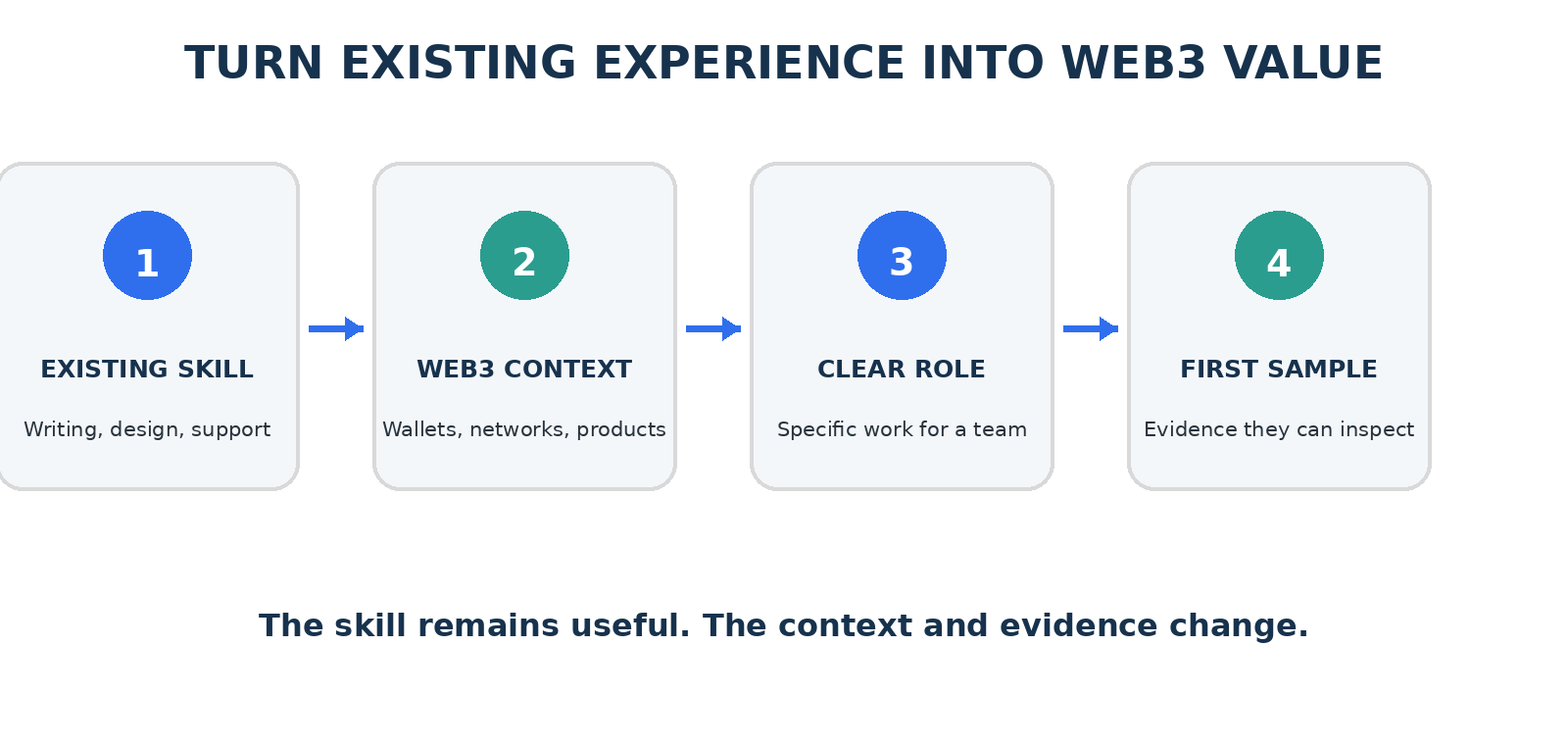
For example, a customer support officer from a bank may understand verification, transaction complaints and anxious customers. To become relevant to a crypto exchange, the person can learn wallet addresses, networks, confirmations, transaction hashes and common security risks. The original support skill remains valuable; the context changes. |
Choose one primary role for the next 60 to 90 days. You can have a secondary skill, but your public profile should make your main value clear. “Web3 content writer who explains wallets and crypto payments for beginners” is easier to understand than “Web3 enthusiast looking for opportunities.”
Learn the Foundations Without Staying in Tutorial Mode
You need working knowledge, not endless certificates. Learn each concept, use it safely, then explain what you learned in your own words. Never experiment with money you cannot afford to lose, and never share a seed phrase or private key.
The beginner knowledge checklist
A better way to study
Read one clear beginner explanation of the concept.
Use a test environment or observe a real product without risking meaningful funds.
Write a short explanation as though you are teaching a friend.
Check the official documentation to correct mistakes.
Turn the lesson into a public post, diagram or portfolio sample.
Example: after learning blockchain explorers, choose a harmless public transaction. Identify the sending address, receiving address, network fee, status and time. Then create a simple guide titled “How to Read a Blockchain Transaction.” This teaches you and creates visible proof of work at the same time. |
Build Proof of Work Before You Are Hired
Proof of work means evidence that you can perform the type of work a company needs. In this context, it does not refer to the blockchain consensus mechanism. It means samples, contributions, results and clear thinking that a hiring manager can inspect.
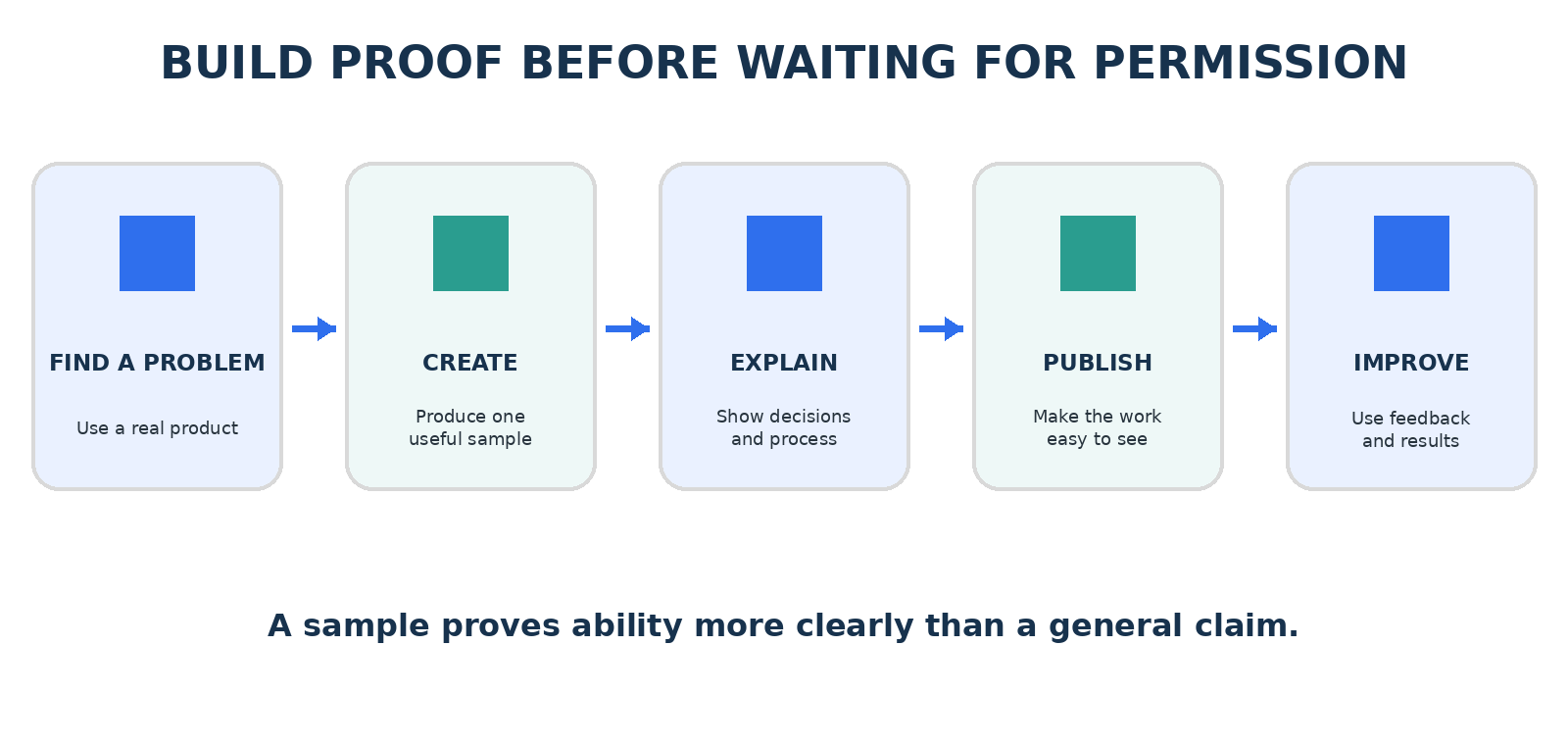
A certificate shows that you completed a course. A strong sample shows how you think and what you can produce. For most beginner non-technical roles, three strong and relevant samples are more useful than twenty unrelated pieces.
Portfolio examples by role
Role | Project 1 | Project 2 | Project 3 |
|---|---|---|---|
Writer | Beginner wallet guide | Product tutorial | Comparison article |
Community manager | Onboarding flow | 30-day engagement plan | FAQ and escalation process |
Marketer | Product positioning review | Launch campaign | Competitor analysis |
Designer | Wallet onboarding redesign | Transaction-status screen | Short UX case study |
Developer | Token-gated demo | Wallet connection app | Open-source contribution |
Researcher | Protocol overview | Risk analysis | Ecosystem report |
Example of a strong project
Imagine you want to become a Web3 content writer. Instead of writing a general article titled “What Is Cryptocurrency?”, select a real wallet product and create a practical tutorial: “How to Receive USDC Without Choosing the Wrong Network.” Include the intended reader, screenshots you created or have permission to use, steps, warnings, and a short explanation of why network compatibility matters. |
At the beginning of the sample, state the problem. At the end, explain what you would improve if you had access to the company’s user data. This shows writing ability, product thinking, user awareness and responsible communication.
Do not present unpaid work as employment
You may independently analyse a company or contribute to an open project, but label the work honestly. Use “independent product analysis,” “sample campaign”, or “community contribution.” Do not suggest that a company hired you when it did not. Trust matters in Web3 because the industry already struggles with fraud and exaggerated claims.
Create a Portfolio That Makes Your Value Obvious
Your portfolio can be a simple website, Notion page or organised document. It does not need complicated animation. It must load properly, work on mobile and help a visitor understand you quickly.
What to include
- A clear headline naming your role and the problems you solve.
- A short introduction focused on your professional value.
- Three to five relevant samples, with your strongest sample first.
- A short case study for each sample: problem, approach, work produced and result or expected result.
- Your contact details and a direct invitation to discuss work.
- Links that open correctly and files that do not require unnecessary access requests.
Weak and stronger positioning examples
Weak | Stronger |
|---|---|
I am passionate about blockchain and looking for opportunities. | I write beginner-friendly product education for crypto wallets and payment platforms. |
I can handle social media. | I create educational social campaigns that turn complex DeFi features into clear user actions. |
I am a hardworking community manager. | I build onboarding, engagement and escalation systems for Web3 communities. |
I am a blockchain developer. | I build and document simple wallet-connected applications using JavaScript and Solidity. |
Use case studies, not just screenshots
A screenshot proves that something exists, but it does not explain your contribution. Under each project, answer four questions: What was the problem? What did you do? Why did you choose that approach? What changed, or what outcome was the work designed to create? If it were a personal project, say so and describe the intended outcome rather than inventing performance numbers.
Gain Experience Through Useful Contributions
You can gain relevant experience before formal employment by contributing to projects. The contribution should be small enough to complete, useful enough to matter and visible enough to verify.
Ways to contribute
Correct a confusing section of open-source documentation and submit a proper change.
Answer genuine beginner questions in a community without pretending to be official support.
Create an unofficial educational thread and clearly label it as independent.
Join a bounty or grant programme with clear terms and a realistic scope.
Translate approved content if you are fluent and the project accepts community translations.
Report a reproducible product issue through the correct channel without exposing sensitive information.
Volunteer for a defined event or community task with an agreed end date.
Avoid becoming permanent free labour. Before accepting unpaid work, define the task, expected output, duration, ownership of the work and whether you can include it in your portfolio. A short strategic contribution can create evidence and relationships. An undefined role that consumes your time for months may not.
Example of a contribution message
Hello Amara, I noticed that new members in the community frequently ask how to move tokens from an exchange to the correct network. I drafted a one-page beginner FAQ based on the official documentation. If it is useful, I can share it for review. I am building experience in Web3 community education, and I would like permission to include the final approved version in my portfolio. |
Quick quiz
Which of these categories is a common non-technical entry point into Web3 companies?
Get new Decode Web3 posts in your inbox.
Add any other topics you want to receive.
These roles let people break in without needing to code, drawing on skills from marketing, ops, and communications backgrounds.
Become Visible Without Spamming People
Many Web3 opportunities move through public conversations and referrals. Visibility helps, but visibility does not mean posting “GM” under every founder’s update or sending the same private message to fifty people. It means repeatedly showing useful knowledge and respectful participation.
A simple weekly visibility routine
Day | Action |
|---|---|
Monday | Explain one concept you learned in simple language. |
Tuesday | Study a product and post one useful observation. |
Wednesday | Respond thoughtfully to three industry conversations. |
Thursday | Share progress on a sample or contribution. |
Friday | Publish a finished piece of work or short case study. |
Weekend | Review what received meaningful responses and plan the next week. |
Quality matters more than constant noise. A useful reply can add an example, identify a risk, answer a question or connect the discussion to user experience. Avoid begging for work in public comments. Let your profile, pinned work and consistent contributions support your job search.
Improve your profile
Use a clear photograph or professional avatar, a headline that names your role, a short description of your focus, a portfolio link and a pinned example of your best work. A person who discovers you through one useful comment should be able to understand your value in less than a minute.
Find Opportunities Beyond Large Job Boards
Popular job boards are useful, but they are crowded, and some listings are already old by the time you see them. Build a target-company system instead of depending only on advertised vacancies.
Create a target list
Choose 30 to 50 companies in the area that interests you. Record the company, product category, website, careers page, relevant team members, role you can perform, evidence of a current need, date contacted and follow-up status. Review the list every week.
Signals of a possible need include a new product launch, expansion into a new country, confusing documentation, an inactive community, a hiring announcement, a funding announcement or repeated user complaints about the same issue. A signal is not permission to attack the company. It is information that helps you make your approach relevant.
Where to look
Official company career pages and company social accounts.
Web3-focused job boards and ecosystem career pages.
Founder, recruiter and department-lead posts on X and LinkedIn.
Discord and Telegram opportunity channels operated by legitimate projects.
Hackathons, bounties, grants, fellowships and contributor programmes.
Open-source repositories and public project roadmaps.
Communities connected to a specific blockchain ecosystem or professional skill.
Verify every opportunity through the official website or a known company representative. A polished social profile is not enough proof that a recruiter is genuine.
Apply With Evidence Instead of Empty Claims
A good application connects the company’s need to your evidence. It does not repeat your entire life story, and it does not use one generic message for every employer.
A practical application structure
Name the exact role and show that you understand the product.
Identify the most relevant problem you can help solve.
Link one or two samples that match the work.
Mention a relevant result honestly, if one exists.
Ask for a clear next step.
Sample application email
Subject: Application for Web3 Content Writer | wallet education samples Hello Daniel, I am applying for the Web3 Content Writer role. I reviewed your wallet’s beginner resources and noticed that network selection is introduced after the first deposit step. My work focuses on explaining wallet and crypto-payment processes to new users. Here are two relevant samples: a guide to receiving stablecoins on the correct network, and a rewritten wallet onboarding flow with explanations for my decisions. Both are available in my portfolio: [link]. I would be glad to discuss how I can support your product education and help reduce confusion for first-time users. Thank you for your time. Regards, |
Sample direct outreach
Hello Tola, I have been studying your payment product and saw that you recently introduced merchant invoices. I created a short independent onboarding concept showing how the feature could be explained to first-time merchants. I am a Web3 product writer, and the sample is here: [link]. If your team needs support with product education, I would be glad to discuss it.
Follow up once after a reasonable period, usually five to seven working days. Add useful context if you have it. Do not send daily reminders or guilt the recipient for not replying.
Prepare for the Interview
The interview is where you prove that your portfolio reflects your own thinking. Study the company’s product, users, competitors, recent announcements and the responsibilities in the job description. Use the product where it is safe and legally available to you.
Questions you should be able to answer
What does this company do, and who uses its product?
Why do you want this role rather than any available Web3 role?
Which portfolio sample is most relevant, and what decisions did you make?
How would you explain the product to a complete beginner?
What major risks or trust concerns affect this product category?
How do you handle something you do not yet understand?
How would you measure whether your work is successful?
Use a clear story when answering
Structure experience answers around the situation, the task, the action you took and the result. If you do not have a formal Web3 result, use a relevant personal project or transferable example and say exactly what it was.
Example: “New users in a community repeatedly asked how to choose the correct network. I reviewed the official documentation, grouped the questions, and created a visual FAQ with an escalation note for uncertain cases. It reduced repeated questions during the week I monitored it and gave moderators one resource to share.” Only make a result claim you can support. |
Protect Yourself From Fake Web3 Jobs
Web3 job seekers are targets for phishing and fraud. Scammers may pretend to be recruiters, send harmful interview files, ask you to connect a wallet, or offer payment that requires you to send money first.
Warning signs
The recruiter uses an unrelated email address and cannot be verified through the company.
You are asked for your seed phrase, private key or wallet recovery information.
You must pay a registration, equipment, training or release fee before working.
The interview requires installing unknown software or opening an unexpected executable file.
The offer arrives immediately without a credible interview or review of your work.
The promised salary is unusually high while the responsibilities remain vague.
You are pressured to act quickly or keep the opportunity secret.
Confirm the role on the official company website. Contact the company through a verified channel if necessary. Use separate, secure passwords and multi-factor authentication. Keep valuable assets away from wallets used for experiments. Never sign a wallet request you do not understand.
A 30 Day Plan for Your First Web3 Job Search
Period | Focus | Deliverables |
|---|---|---|
Days 1–5 | Choose one role and one Web3 area. Audit your transferable skills. | One positioning statement, a learning checklist and a list of ten companies. |
Days 6–10 | Learn the essential concepts connected to the role. | Five short explanations and one practical exercise. |
Days 11–17 | Build your strongest sample project. | One complete, well-presented portfolio piece. |
Days 18–21 | Create two smaller supporting samples and organise your profile. | Portfolio with three samples; updated LinkedIn or X profile. |
Days 22–25 | Join relevant conversations and make useful contributions. | Ten thoughtful interactions and one verifiable contribution. |
Days 26–30 | Apply and conduct targeted outreach. Review responses. | Ten tailored applications, five outreach messages and a tracking sheet. |
Your daily minimum
If you have limited time, spend 30 minutes learning, 45 minutes building, 20 minutes participating in useful conversations and 25 minutes researching or applying. Adjust the schedule to your reality, but protect the building time. Consuming information without producing work will not create a portfolio.
Track the process
Record the opportunities you pursue, the sample you sent, the response, the interview stage and the lesson. After every ten applications, look for a pattern. If nobody opens your portfolio, improve your approach and links. If people view it but do not interview you, strengthen relevance and presentation. If you interview but do not progress, practise your explanations and study the role more deeply.
Common Mistakes to Avoid
Applying for every role. It makes your profile unclear and prevents focused skill development.
Collecting courses without producing work. Learning matters, but employers need evidence that you can apply it.
Copying other people’s content. It damages trust and leaves you unable to defend the work in an interview.
Using complicated language to sound knowledgeable. Clear explanations usually show stronger understanding.
Pretending to have results. Separate actual outcomes from expected outcomes and personal projects from client work.
Depending only on job boards. Combine applications with company research, contributions, relationships and direct outreach.
Ignoring security. A job search is not worth exposing your identity, device, accounts or digital assets.
Giving up after one week. A serious search requires repeated learning, building, applying and improving.
Final Checklist Before You Apply
Final Thoughts
Your first Web3 job is unlikely to come from saying that you are passionate about Web3. It will come from showing that you understand a real problem and can contribute to solving it.
- Choose a role.
- Learn the part of Web3 connected to that role.
- Build useful examples.
- Share your work.
- Contribute carefully.
- Research companies and send applications that connect your evidence to their needs.
- Then study every response and improve the weak part of your process.
You do not need to know everything before you begin. You need enough understanding to work responsibly, enough focus to become useful, and enough evidence for another person to trust you with an opportunity.
Glossary
Term | Simple meaning |
|---|---|
Blockchain | A shared digital record maintained according to network rules. |
Wallet | A tool that manages keys and allows a user to interact with blockchain assets. |
Seed phrase | A sensitive recovery phrase that must never be shared. |
Smart contract | Code on a blockchain that performs defined actions. |
dApp | An application that interacts with blockchain networks or smart contracts. |
Gas fee | A network fee paid to process a blockchain action. |
Stablecoin | A token designed to maintain a relatively stable value, often linked to a currency. |
DeFi | Blockchain-based financial products such as trading, lending or liquidity services. |
DAO | A blockchain-oriented community or organisation that may coordinate through shared governance. |
On-chain | Activity or data recorded on a blockchain. |
Protocol | A system of rules and smart contracts that powers a blockchain product. |
Proof of work for your career | Visible evidence (samples, contributions and results) that you can perform a role. |
Join the conversation
What stayed with you? Leave a thought or a question. Comments appear after approval.
Loading comments…