On Monday, 15 September 2026, traders at the Lagos International Trade Fair Complex along the Lagos-Badagry Expressway staged a protest. The traders were not protesting against Chinese products. They were protesting against something more specific.
Chinese nationals who initially came into the country to engage in wholesale trade had gradually expanded into retail, selling directly to Nigerian consumers and undercutting local sellers on price. Some had rented shops and built warehouses within the complex. Some had obtained customers' phone numbers from waybills to solicit sales directly, a practice traders said was eroding their customer base.
Before now, we often talk about Chinese products entering Nigeria because they are cheaper. For consumers, that can sound like an obvious benefit. Cheaper products mean people can buy more with less money, especially in an economy where household purchasing power is already under pressure.
But there is another side to the conversation that deserves more attention.
The people who may feel the impact first are not necessarily the big businessmen with substantial capital. They are the small retailer, the local manufacturer, the importer, the e-commerce seller, the person selling from Instagram, or the person running a small shop and trying to keep a business alive.
The question is not whether Nigerians should have access to cheaper products. Of course they should. The question is what happens when businesses connected to an enormous manufacturing ecosystem begin competing directly with small Nigerian businesses that are already operating under high financing, electricity, logistics and other operating costs.
For Example:
A small Nigerian streetwear business making T-shirts locally.
An XXL T-shirt may require about two yards of fabric. If one yard costs ₦3,000, the fabric alone costs about ₦6,000.
The business still has to pay for sewing, labour, fuel, transportation, packaging and other operating expenses. There is also the problem of electricity. Where public supply is unreliable, the business may have to run a generator and buy fuel simply to keep production going.
After covering those costs, the seller may put the T-shirt on the market for ₦15,000. A customer then find a similar-looking product online for around ₦7,000.
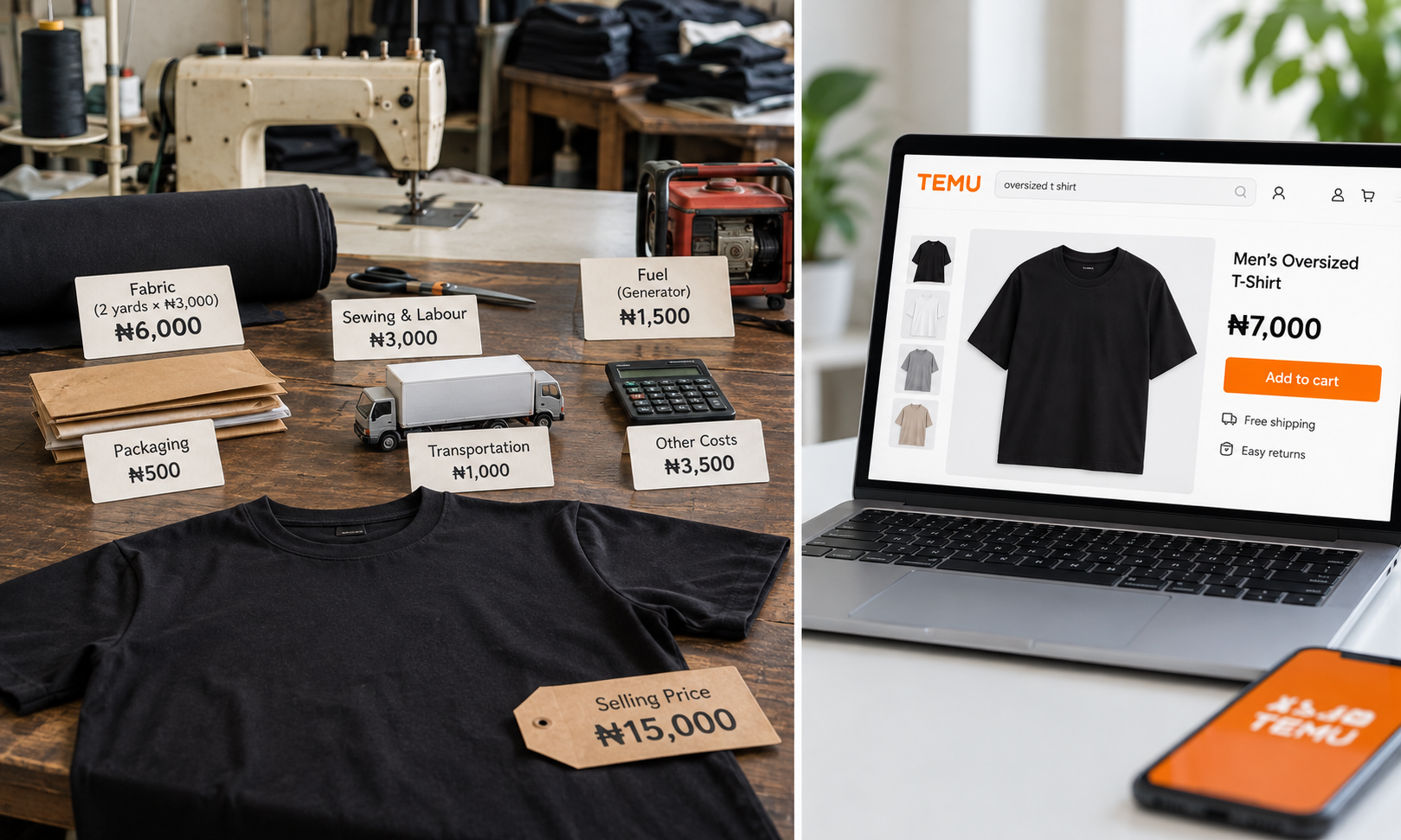
From the customer's perspective, the Nigerian seller may simply appear too expensive. But the two businesses are not necessarily operating within the same production environment.
One is producing at a relatively small scale while carrying the full cost of local production. The other may be connected to a massive manufacturing and supply-chain ecosystem capable of producing huge volumes at much lower unit costs.
So how exactly is a small Nigerian business supposed to compete on price alone?
The discussion about Chinese businesses in Nigeria needs to move beyond the question of whether Chinese products are cheap.
Cheap products are useful. Imports are useful. Foreign investment is useful. Technology transfer is useful. Nigerian businesses themselves rely on international supply chains, including Chinese suppliers, to source machinery, components, fabrics, electronics and other inputs.
The issue arises when Nigeria becomes increasingly dependent on imported finished products while the businesses that should be developing local productive capacity remain weak.
If local businesses disappear from important parts of the value chain, the immediate consumer may get a cheaper product, but the economy loses local production, business ownership, jobs, supplier networks, technical knowledge and opportunities for businesses to scale.
That does not mean every import destroys local industry. It means policymakers have to think about the cumulative effect of trade patterns on domestic productive capacity.
We often talk about Chinese businesses in Nigeria as a price competition problem. But what happened at the Lagos Trade Fair Complex is bigger than that.
When a Chinese wholesaler starts selling directly to Nigerian consumers, the Nigerian retailer is not just losing customers because someone is cheaper. They are being cut out of the transaction completely.
And the effect spreads.
- The retailer loses income.
- Workers lose jobs.
- Local suppliers lose customers.
- Landlords lose tenants.
- The government loses tax revenue.
Even the years of experience, customer relationships and business networks that a retailer has built disappear. This is how an economy can take a quiet hit. Not because one business closes, but because many local businesses gradually lose their place in the economy.
So the issue is not simply that Chinese businesses are cheaper. The bigger question is: what happens to Nigerian businesses when they are no longer part of the transaction?
Nigeria can still record GDP growth while local businesses are being pushed out.
People are still buying. Imports are still coming in. Money is still changing hands.
But GDP does not tell us where the value is being created or who is capturing it.
When a Nigerian business closes, the loss goes beyond the owner.
- Workers lose income.
- Suppliers lose customers.
- Landlords lose rent.
- The government loses tax revenue.
- The money that would have circulated through several local businesses now leaves the local economy through imports and foreign-owned supply chains.
That is the multiplier effect in reverse.
The more Nigeria depends on imported goods and foreign businesses to control the distribution of those goods, the less economic value stays within Nigeria.
So the issue is bigger than Nigerian traders losing customers.
It is about Nigeria gradually losing the businesses, jobs, supply chains and local spending that make an economy productive.
An economy can be busy and still be becoming weaker underneath.
Before we say, “Let Nigerians manufacture”
This is where another argument usually appears: if Nigerian businesses cannot compete with Chinese products, then Nigerians should simply manufacture their own products.
That sounds reasonable until we look at what manufacturing actually requires.
Manufacturing requires electricity, machinery, financing, roads, logistics, skilled labour, reliable suppliers, access to markets and an environment where businesses can invest for the long term.
World Bank research found that Nigerian manufacturing firms were without electricity for about 40 percent of the time on average, almost 10 hours a day, with roughly 70 percent of firms owning or sharing private diesel generators. The research identifies electricity reliability as an important constraint on manufacturing competitiveness.
That means the electricity problem is not simply an inconvenience. It becomes part of the cost of producing every item.
Get new Omenala posts in your inbox.
Add any other topics you want to receive.
A manufacturer that has to generate a significant portion of their own electricity is carrying a cost that a manufacturer with reliable power does not carry in the same way.
And electricity is only one part of the problem. The cost of money matters too.
The Central Bank of Nigeria reported an average maximum lending rate of 30.11 percent in April 2025. More recent data reported from the Manufacturers Association of Nigeria showed that manufacturers paid an average borrowing rate of 32.1 percent in 2025, down from 35.6 percent in 2024.
Meanwhile, the People's Bank of China reported that the weighted average interest rate on newly issued inclusive loans to micro and small enterprises was 3.69 percent in May 2025, while the rate for newly issued loans to privately controlled enterprises was 3.45 percent.
These are not perfectly comparable measures, so they should not be presented as though they measure exactly the same thing. But they illustrate a very important difference in the financing environments businesses can face.
So when someone says, “Let them come and compete,” there is another question we need to ask: Are both sides actually competing from comparable starting conditions?
China's advantage did not come from cheap products appearing by magic. It was built through decades of investment in manufacturing capacity, supplier networks, industrial clusters, logistics, infrastructure, skills, technology and finance.
That creates economies of scale.
A factory producing hundreds of thousands or millions of units can spread many costs across a much larger number of products. It can buy inputs in larger quantities, specialise, build relationships with suppliers and develop dedicated logistics channels.
A small Nigerian business producing a few hundred or a few thousand units cannot automatically reproduce those economics.
This is why the conversation should not be reduced to the character or effort of individual Nigerian business owners. The structure in which the business operates matters.
Now, before you say, “Nigerians are also doing businesses in China, why do we want to restrict the China business in Nigeria”?
Note that if a Nigerian wants to establish a business in China, the person does not simply arrive, open a shop and begin operating without regard to Chinese investment rules. China has a formal legal framework governing foreign investment.
Under China's Foreign Investment Law, the country uses a system of pre-establishment national treatment plus a negative list. Foreign investors receive national treatment in sectors outside the negative list, while sectors on the list can be prohibited or subject to specific conditions.
The 2025 national negative list, which took effect on 1 November 2024, reduced the number of restricted measures from 31 to 29 and removed the remaining restrictions on foreign investment in manufacturing. Restrictions still remain in specific areas, including parts of agriculture, natural resources, transport, certain services and other strategically sensitive sectors.
The framework also means foreign investors cannot simply operate as individual entrepreneurs or sole proprietors under the foreign-investment regime. Depending on the sector and structure, they need an appropriate business structure, registration and, where applicable, sector-specific licences.
A country can welcome foreign investment while still deciding where investment is restricted, what licences are required, what ownership conditions apply and how market access is administered.
Although Nigeria also has investment rules, the question is how effectively those rules are enforced, and whether the overall policy environment is helping Nigerian businesses build productive capacity.
The NIPC states that foreign participation is permitted across open sectors subject to the applicable legal framework and that foreign investors receive protections, including repatriation of capital and returns, under the NIPC Act.
Regulation should not simply be about making it difficult for foreign businesses to enter. It should also be about ensuring that the benefits of openness are consistent with Nigeria's long-term economic development.
I am not arguing that Chinese people should not do business in Nigeria. I am not arguing that Chinese products should not enter Nigeria. I am not arguing that Nigeria should isolate itself from international trade.
Nigerians benefit from cheaper products. Nigerian businesses benefit from access to Chinese suppliers. Manufacturers need imported machinery and components. Consumers need affordable goods. Foreign investment can bring capital, skills, technology and access to international networks.
The issue is balance. If foreign businesses can enter a market with enormous capital, production capacity and established supply chains, while local businesses are still struggling with electricity, financing and infrastructure, the government has to think about how to develop domestic capacity at the same time.
Let’s not forget that China has consistently ranked among Nigeria's largest sources of imports. In the fourth quarter of 2023, China accounted for ₦2.06 trillion, or 14.61 percent, of Nigeria's total imports for that quarter, according to the National Bureau of Statistics.
In the second quarter of 2023, China accounted for 22.17 percent of Nigeria's imports.
These quarterly figures show that China is not a marginal trading partner for Nigeria. Chinese goods are deeply embedded in the Nigerian market.
Although that relationship brings benefits, it also creates a dependency question.
What happens if more and more of the products Nigerians consume are produced elsewhere, while Nigerian businesses increasingly occupy only the importing and retailing end of the chain?
Nigeria will become very good at consuming what other countries produce without becoming equally good at producing what Nigerians and the rest of the world need.
Finally, when we talk about Chinese businesses dominating the Nigerian market, we often think about the big Nigerian businesses and billionaires.
But the first people affected may be much smaller.
It could be the person with a small shop. The Instagram seller. The e-commerce business owner. The local manufacturer with 10 or 20 workers. The distributor who spent years building a customer base. Or the young entrepreneur who borrowed money to buy stock.
These businesses may not have the capital to survive a prolonged price war.
When local businesses disappear, the economy weakens.
Nigeria gets the consumption, but not enough of the production that sustains it.
This is not about closing Nigeria off from the world.
It is about being deliberate about the kind of economy we are building, and making sure Nigerians are not pushed further and further away from the value chain.
Join the conversation
What stayed with you? Leave a thought or a question. Comments appear after approval.
Loading comments…